Cookies Text Effect: The Smart Object Design Shortcut
You know that moment when you're staring at a blank canvas, trying to figure out how to make your text pop without spending hours tweaking layer styles? We've all been there. Whether you're putting together a quick social media post or designing a full brand identity, getting that polished, three-dimensional look on your typography can feel like pulling teeth. That's exactly where the Cookies Text Effect steps in—not as another complicated tutorial, but as a genuine time-saver for anyone who needs professional-looking text without the professional-level hassle.
What Makes This Text Effect Different
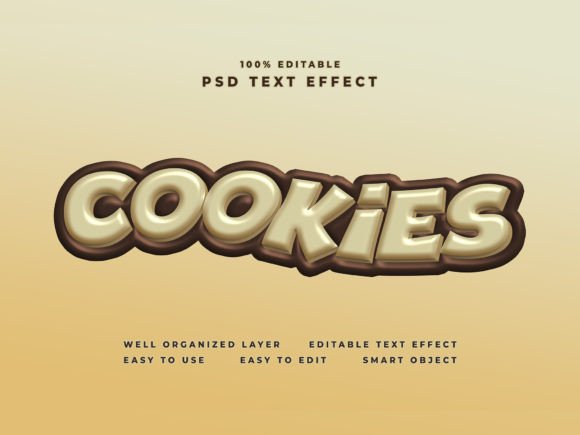
Let's be honest about what we're working with here. The Cookies Text Effect isn't a font in the traditional sense—it's a Photoshop smart object template that transforms whatever text, shape, or logo you throw at it into a stylized, dimensional design. Think of it as a visual filter with personality. The effect gives your content a textured, almost edible appearance that catches the eye immediately. It's bold, it's playful, and it works surprisingly well across a range of projects where you need your message to stand out from the noise.
What sets it apart from slapping a basic bevel on your text? The layers are built with intention. Every shadow, highlight, and texture has been carefully constructed so that when you drop your design into the smart object, the result actually looks like someone spent real time crafting it. At 4000 by 6000 pixels in 4K quality at 300 dpi, you're not getting some low-resolution shortcut that falls apart when you try to print it. This is production-ready material.
Real Projects Where This Effect Shines
Picture this: you're a small business owner launching a bakery, and you need promotional materials that feel warm and inviting. A poster with the Cookies Text Effect applied to your tagline instantly communicates that handcrafted, artisanal quality before anyone reads a single word about your sourdough. The visual texture does the heavy lifting while your copy seals the deal.
Now think about social media. Instagram feeds are relentless—everyone's competing for that half-second of attention as someone scrolls. A YouTube thumbnail or Facebook cover using this effect gives your channel or page an immediate visual identity. It doesn't look like you copied a template off the internet. It looks intentional. And for content creators who post regularly, having a consistent visual treatment across your graphics builds recognition faster than most people realize.
Here's where it gets practical for different types of projects:
- Brand identity work — Use it for logo presentations, business card mockups, or brand style guides where you want to show clients how text treatments can elevate their visual presence.
- Packaging design — Product labels, box designs, and retail packaging benefit enormously from textured typography that stands out on crowded shelves.
- Event materials — Invitations, flyers, and posters for everything from birthday parties to corporate events get an instant personality boost.
- Editorial layouts — Magazine covers, blog headers, and digital publication titles that need to feel premium without the premium timeline.
- Merchandise — T-shirt designs, tote bags, and promotional products where bold, stylized text is the entire point.
- Website banners — Hero images and promotional banners that need to communicate energy and creativity at first glance.
For marketers running campaigns, this kind of design asset is gold. Instead of briefing a designer for every single social post or ad variation, you can maintain visual consistency across dozens of pieces yourself. That's not about cutting corners—it's about working efficiently when speed matters.
The Smart Object Workflow That Actually Works
Here's the part that makes this genuinely useful rather than just another pretty template. The entire editing process runs through Photoshop's smart object system. If you've never used smart objects before, the concept is simple: you double-click a layer, a new window opens, you paste or type your design, save it, and close the window. Your text or logo automatically inherits every single effect that's been pre-built into the template.
No fiddling with layer styles. No adjusting drop shadows by pixel increments. No wondering why your gradient overlay looks nothing like the preview. The heavy lifting has already been done. You're just swapping out the content.
The file comes organized with well-labeled layers and folders, which matters more than people give it credit for. Ever opened a Photoshop file where everything is named "Layer 47" and "Layer Copy 2"? That's a nightmare, especially if you want to customize colors or adjust individual elements. Proper organization means you can actually modify things without accidentally breaking the entire effect.
For anyone who's purchased design assets before and found them frustrating to work with, the included documentation makes a real difference. The "How to Use PSD Text Effect" guide walks you through the process step by step, and the font reference file tells you exactly which typeface was used in the preview so you can match it if needed.
Pairing This Effect With the Right Typography Choices
One thing worth considering: not every typeface plays equally well with dimensional text effects. Bold, blocky fonts tend to give the texture more surface area to work with, which usually produces the strongest results. Thin, delicate serifs can get lost when you add heavy shadows and highlights. If you're using a script font or handwritten style, make sure the letterforms are thick enough that the effect enhances rather than obscures them.
This is where thinking about your project goals really matters. A cinematic title sequence calls for different typography than a children's party invitation. The Cookies Text Effect adapts to both scenarios, but the font you pair it with should reinforce the mood you're after. Sans serif fonts with strong geometric shapes give you a modern, confident look. Display fonts with personality add warmth and character. Testing a few options inside the smart object before committing to a final version takes five minutes and saves you from settling for something that's almost right.
Readability also deserves attention. Effects like these work beautifully at larger sizes—think headlines, titles, and featured text. At smaller sizes, the textures can muddy the letterforms. Use this for your big moments, not your body copy. Let a clean, simple typeface handle the supporting text while the Cookies Text Effect carries the visual weight of your primary message.
Building a Consistent Visual Language
Consistency is what separates amateur design from professional work. When your audience sees the same visual treatment across your Instagram posts, your website headers, your email newsletters, and your printed materials, they start to recognize you before they even read your name. That's brand recognition in action, and it doesn't require a massive budget—just intentional choices applied repeatedly.
The Cookies Text Effect becomes part of that toolkit. Use it across your social media graphics for a cohesive feed aesthetic. Apply it to your blog headers so readers immediately know they're in your space. Build your YouTube channel art with it so your brand feels unified from thumbnail to banner. The more consistently you deploy a specific visual style, the stronger that association becomes in your audience's mind.
For entrepreneurs and small business owners who wear every hat in the company, having reliable design assets that produce consistent results isn't a luxury—it's a necessity. You don't have time to learn advanced Photoshop techniques from scratch. You need tools that respect your time while still delivering work that looks like you hired a professional. That balance is exactly what a well-constructed smart object template provides.
Before you start any project, take a minute to think about context. Where will this design live? What size does it need to be? Who's the audience? A poster for a craft fair has different visual requirements than a LinkedIn banner for a consulting firm. The effect itself is versatile, but your application of it should be deliberate. Match the energy of the design to the expectations of your audience, and you'll get results that actually move the needle—whether that's more clicks, more sales, or simply more people paying attention to what you've created.